
INTRODUCTION:
A UV/Vis spectrophotometer looks simple and easy to operate; however, the results depend on a chain of components: source lamps, monochromator, sample compartment, cuvettes and detector. Drift or contamination anywhere in any of the component produces data that looks plausible but is wrong. Good maintenance protects data quality, extends instrument life.
Maintenance falls into three layers:
- User care: what every operator does on every use
- Performance verification: scheduled checks against traceable standards
- Preventive and corrective service: lamp changes, alignment and repairs
USER CARE
ENVIRONMENT AND INSTALLATION
- Place the instrument on a stable, vibration-free bench, away from centrifuges, pumps and heavy foot traffic.
- Avoid direct sunlight, air-conditioning vents and drafts. Check your manual.
- Keep it away from corrosive vapours (acids, ammonia, chlorinated solvents). These attack mirrors, gratings and electronics.
- Use a stable, grounded power supply. A UPS or surge protector is worthwhile in places with unreliable mains power.
- Keep the sample compartment lid closed when not in use to limit dust and stray light.
- For deep-UV work below about 190 nm, nitrogen purging of the optics is needed to remove oxygen absorption.
DAILY PRACTICE
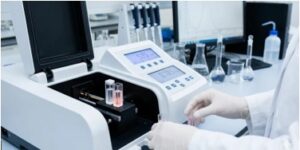
Before measuring
- Power the equipment and allow the lamps to warm up for the period of 15-30 minutes, or as specified by the manufacturer. Measuring before the lamp stabilizes lead to baseline drift.
- Check the sample compartment is clean, dry and free of debris or old spills.
- Run a baseline or auto-zero with the same solvent or blank, in the same type of cuvette, that you will use for samples.
During measurement
- Aim for absorbances between about 0.1 and 1.0 (ideally 0.2-0.8).
- Filter or centrifuge turbid samples. Particles scatter light and inflate absorbance.
- Remove air bubbles and avoid fingerprints on the optical faces.
- Be aware of solvent UV cut-offs. For example, acetone absorbs strongly below about 330 nm, so it cannot be used as a blank or solvent in the UV.
- Do not leave volatile, corrosive or photosensitive samples sitting in the compartment.
After measuring
- Remove all samples and cuvettes, wipe up any drips immediately, and close the lid.
- Turn off the instrument when not in use and do not leave it on unnecessarily overnight.
Cuvette Cleaning and Handling
By taking proper precaution most errors due to cuvette can be avoided.
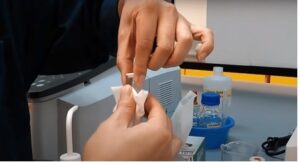
Handling
- Hold cuvettes by the frosted or ribbed sides, never the clear optical faces.
- Always insert the cuvette in the same orientation (mark the top edge).
- Use matched cuvettes for reference and sample where high accuracy is needed, and check them against each other periodically with the same solvent in both.
Cleaning
- Rinse immediately after use with the solvent that dissolved the sample, then with deionised water or high-purity solvent.
- For stubborn residue, soak in a suitable cleaner (dilute nitric acid or a lab-grade cuvette cleaner, following the supplier’s instructions). Rinse thoroughly afterwards.
- Never use abrasive wipes or brushes, which scratch the optical surface. Do not use hot strong alkali or hydrofluoric acid on quartz.
- Do not oven-dry or ultrasonicate cuvettes unless the manufacturer says they tolerate it. Some cuvettes have cemented joints that fail with heat or aggressive solvents.
- Dry with a stream of clean air or nitrogen, or let them air-dry upside down in a dust-free place. If wiping is unavoidable, use lens tissue.
- Store dry, in a closed case or rack, protected from dust.
Inspect regularly
Inspect regularly to see if there are cracks, scratches, residue films and chipped edges. Replace any damaged cuvettes rather than compensating with baseline corrections.
Lamps and light sources
Most instruments use a deuterium lamp for the UV (about 190-350 nm) and a tungsten-halogen lamp for visible. However, some use xenon lamp, which has a long life.
- Signs of a failing lamp: increased noise at short UV wavelengths, unstable baseline, reduced energy, difficulty passing the baseline or energy checks and others.
- Replacement: switch off, unplug and let the lamp cool fully first. Never touch a halogen bulb with bare fingers, because skin oils cause hot spots and early failure. Use gloves or a lint-free cloth. Fit the lamp as specified and realign or recalibrate if the manual requires it.
- Safety: deuterium lamps emit UV radiation that damages eyes and skin, so never look at a lit lamp or operate the instrument with the lamp housing open. Lamps run hot and contain gas under low pressure, so dispose of them according to your site’s waste rules.
- Record the installation date and lamp hours in the instrument logbook.
Optics and Sample compartment
- Do not touch mirrors, gratings, lenses or windows. They are delicate, often front-surface coated, and can be damaged easily. Internal optics should be cleaned by trained service personnel.
- Clean the sample compartment floor and cuvette holder with a lightly moistened lint-free wipe. If a spill reaches the internals, switch off and call service.
- Check cuvette holders, sipper or flow cells, autosamplers and Peltier temperature controllers for residue and leaks. Flush flow cells and tubing with solvent after every use, and use a suitable cleaning solution periodically.
- For fibre-optic probes, dip probes and integrating spheres, follow the accessory manual. Keep fibre ends and sphere coatings clean, dry and uncontaminated, and never touch the reflective sphere coating.
REFERENCES:
International Organization for Standardization, & International Electrotechnical Commission. (2017). ISO/IEC 17025:2017: General requirements for the competence of testing and calibration laboratories. International Organization for Standardization. https://www.iso.org/standard/66912.html
United States Pharmacopeia. (2022). General chapter 〈857〉: Ultraviolet-visible spectroscopy. USP–NF. https://doi.org/10.31003/USPNF_M3209_03_01
United States Pharmacopeia. (2022). General chapter 〈1857〉: Ultraviolet-visible spectroscopy—Theory and practice. USP–NF. https://doi.org/10.31003/USPNF_M5513_02_01
Burgess, C. (2017). The basis for good spectrophotometric UV–visible measurements. In UV-visible spectrophotometry of water and wastewater (2nd ed., pp. 1–35). Elsevier. https://doi.org/10.1016/B978-0-444-63897-7.00001-9