
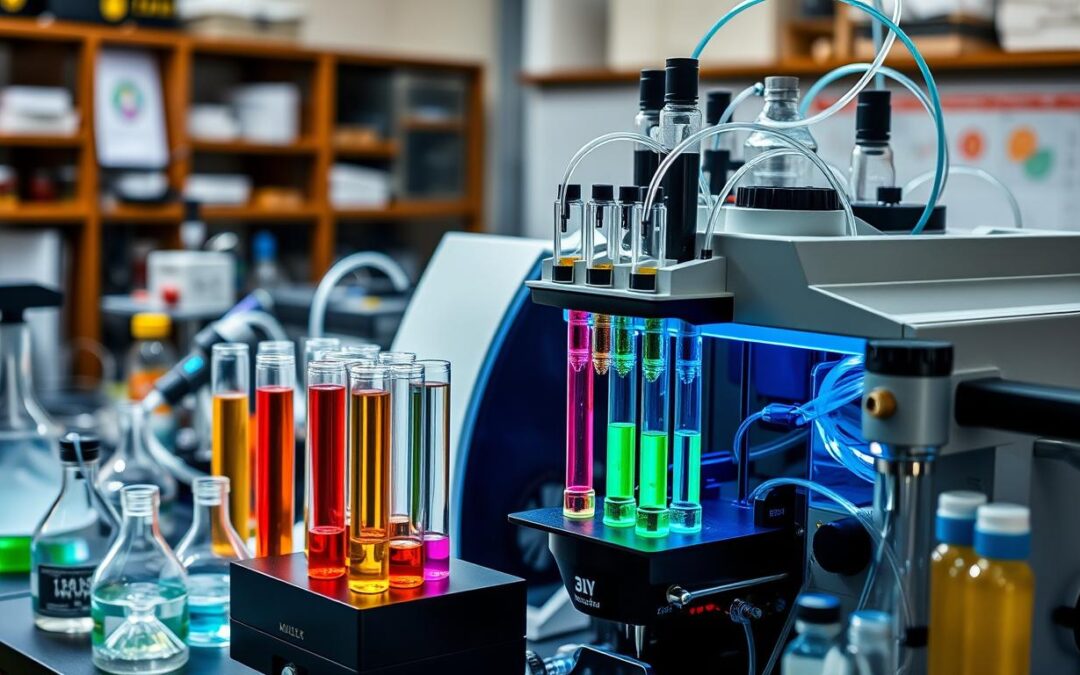
In today’s world, finding trace impurities is key in many fields. This includes electronics, pharmaceuticals, and environmental monitoring. To keep products safe and meet rules, we need top-notch ways to spot these impurities. Gas Chromatography Mass Spectrometry (GC-MS) is a leading method. It combines two powerful tools to analyze gases and liquids.
Key Takeaways
- GC-MS is a highly effective technique for trace impurity analysis in natural gas samples.
- Precise sample preparation and volatilization are essential for obtaining accurate and reliable results.
- Mass spectrometry detection provides enhanced sensitivity and specificity for compound identification.
- Column technology and retention time analysis are crucial for effective separation and quantification.
- Proper gas purification and filtration systems ensure high-purity carrier and detector gases for optimal performance.
Understanding Gas Chromatography Mass Spectrometry (GC-MS) Fundamentals
Gas Chromatography Mass Spectrometry (GC-MS) is a top-notch analytical method. It combines gas chromatography (GC) for separation with mass spectrometry (MS) for detection and identification. This combo is key for analyzing complex mixtures, especially hydrocarbon contaminants, sulfur compounds, and permanent gases.
Principles of Sample Volatilization and Separation
The sample is first turned into gas in a GC-MS system. Then, it moves through a special column with an inert gas like helium or nitrogen. The column’s coating interacts with the sample, separating it based on boiling points and affinities.
The time it takes for a compound to move through the column is crucial. It’s called the retention time. This time helps identify and measure specific molecules.
Mass Spectrometry Detection and Analysis
After separation, the compounds go into the mass spectrometer. Here, they break down into fragments under electron impact ionization. These fragments are then detected and their mass-to-charge ratios (m/z) are measured.
The mass spectrum gives a unique “fingerprint” for each compound. This allows for identification through library matching and quantitative analysis.
Column Technology and Retention Time Analysis
The type of GC column and its stationary phase are vital for separation and identification. Different columns can be chosen to improve resolution and peak shapes for specific analytes. Analyzing the retention time of each compound is a key step in identification and quantification.
GC-MS is the top choice for detecting trace impurities in natural gas. It offers unmatched sensitivity, selectivity, and can handle complex matrices. Understanding GC-MS helps researchers and analysts get valuable insights into natural gas composition and quality.
“GC-MS provides highly sensitive detection of ions in the gaseous phase, making it an indispensable tool for researchers working with hydrocarbon contaminants, sulfur compounds, and permanent gases.”
Essential Components of Trace Impurity Analysis in Natural Gas
Keeping natural gas pure is key for the petrochemical industry and environmental monitoring. Super gas clean filters are crucial in this effort. They help ensure the purity needed for advanced tests like gas chromatography (GC) and more.
These filters protect analytical tools from impurities. They stop bleed and damage to columns, keeping results stable and accurate. This is vital for precise trace analysis.
- Super gas clean filters ensure gases for GC, GC-MS, ICP-M, and LC-MS have the desired purity for trace analysis.
- These filters help protect instruments and extend column lifetimes by minimizing stationary phase bleed and column degradation.
- Impurities in nebulizing gases for ICP-MS and LC-MS can reduce sensitivity and degrade data authenticity.
With these components, natural gas analysis and the petrochemical industry get reliable results. This supports environmental monitoring and improves natural gas analysis data quality.

Advanced Sample Preparation Methods for GC Analysis
When it comes to finding trace impurities and hydrocarbon contaminants in natural gas, the first step is key. Scientists have come up with advanced ways to get samples ready for GC techniques. These methods help pull out and focus on the tiny parts of the sample before it goes into the GC-MS system.
Thermal Desorption Techniques
Desorption tests use a controlled helium flow and temperatures from 40°C to 300°C. The analytes are caught on a cold trap. This makes sure they are well extracted and concentrated before they enter the GC-MS system.
Pyrolysis and Derivatization Approaches
For samples that can’t be directly put into the GC-MS, pyrolysis is used. Heat up to 1400°C breaks down the big molecules into smaller, easier-to-analyze pieces. Derivatization also helps by making some analytes more volatile and stable.
Static Headspace and SPME Methods
Other methods include static headspace analysis, purge and trap, and solid-phase microextraction (SPME). These are chosen based on the sample and what’s being looked for. They help get the sample ready for GC-MS analysis.
| Sample Preparation Method | Principle | Application |
|---|---|---|
| Thermal Desorption | Analyte extraction under controlled temperature and gas flow | Volatile and semi-volatile organic compounds |
| Pyrolysis | Thermal decomposition of complex molecules into smaller, volatile fragments | Analysis of materials not directly injectable into GC-MS |
| Derivatization | Chemical modification to improve volatility and thermal stability | Polar and thermally labile compounds |
| Static Headspace | Equilibrium partitioning of analytes between sample matrix and headspace | Volatile organic compounds in liquids and solids |
| SPME | Adsorption of analytes onto a coated fiber, followed by thermal desorption | Trace-level organic contaminants in complex matrices |
These advanced methods, combined with GC-MS analysis, help scientists find and measure even the smallest trace impurities and hydrocarbon contaminants in natural gas.

Detecting Trace Impurities in Natural Gas: Advanced GC Techniques
In the world of natural gas analysis, advanced gas chromatography (GC) techniques are key. They help find and measure tiny impurities. These new methods can spot volatile organic compounds, study outgassing, test for residual solvents, and check extracts from plastics.
These advanced GC techniques are great at finding tiny organic contaminants. They can spot them at very low levels, even in liquids and solids. This is thanks to dynamic headspace analysis, which is very accurate for volatile or derivatizable compounds.
For samples that aren’t volatile, extra steps like extraction or outgassing are needed. This makes sure even tough samples get checked thoroughly. It gives us important info about what’s in natural gas and any possible contaminants.
Using advanced GC with other methods like mass spectrometry (GC-MS) and Fourier-Transform Infrared Spectroscopy (GC-FTIR) makes things even better. These methods together can find and measure tiny impurities very well. They’re super sensitive and specific, catching even the hardest-to-find compounds.
| Analytical Technique | Application | Key Capabilities |
|---|---|---|
| Gas Chromatography-Mass Spectrometry (GC-MS) | Trace impurity identification and quantification | Precise molecular composition analysis, even for trace impurities |
| Fourier-Transform Infrared Spectroscopy (GC-FTIR) | Detection of water vapor and hydrocarbon impurities | Effective for identifying and quantifying water and hydrocarbon contaminants |
| Advanced Gas Sensors | Real-time monitoring of impurities in hydrogen storage and transportation | Solid-state and metal-oxide sensors for immediate impurity detection |
| Nuclear Magnetic Resonance (NMR) Spectroscopy | Structural analysis of complex hydrocarbon impurities | Provides detailed information on the molecular structure of impurities |
By using these advanced GC techniques, natural gas producers and processors can learn more about their gas. They can improve their operations, keep their products clean, and meet high standards for natural gas quality and safety.
Gas Purification Systems and Filter Technologies
In the petrochemical industry, keeping gas pure is key. Gas purification systems and filters are vital. They help find trace sulfur compounds and measure permanent gases accurately. These systems and filters clean out impurities, protecting the quality of the final product.
Ultra-High Capacity Filtration Methods
Ultra-high capacity filters are a big step forward in gas purification. They last longer and work better, needing less replacement. These filters remove many contaminants, like moisture and hydrocarbons, from gases. This ensures the gas is 99.9999% pure.
Specialized Filter Applications for Different Gas Types
The petrochemical industry needs special filters for different gases. For example, there are triple filter kits for MS/ECD/NPD systems and fuel gas triple kits for FID. There are also ultra-capacity filter sets for various uses. Helium-specific filters are made for GC/MS systems, keeping helium very pure.
| Filter Type | Application | Purification Capabilities |
|---|---|---|
| Triple Filter Kits | MS/ECD/NPD systems | Removal of moisture, oxygen, and hydrocarbons |
| Fuel Gas Triple Kits | FID | Purification of carrier and detector gases |
| Ultra-Capacity Filter Set Kits | Multiple gas applications | Extended life and enhanced productivity |
| Helium-Specific Triple Filters | GC/MS systems | Targeted purification of helium carrier gas |
Using these advanced systems and filters, the petrochemical industry can reliably detect sulfur compounds and measure gases. This ensures the production of high-quality products.
Quality Control and Performance Optimization
Keeping performance high and quality control tight is key for good environmental monitoring. Techniques like gas chromatography (GC) need careful attention for top-notch results.
High-purity gases and special filters are key for quality control. Easy-to-read indicators help keep filters in top shape. This ensures the gas is clean.
Filters must be placed right in the gas line. Moisture filters go first, followed by oxygen and hydrocarbon filters. Oxygen filters are last to keep the chromatograph safe.
Regular checks on filters are a must. They help spot wear or contamination early. Cleaning parts often stops contamination and residue.
Stable gas supply and column care are also vital. Calibrating with certified standards and good data management boost results. This makes trace impurity analysis reliable.
Following these steps helps labs get accurate and consistent environmental monitoring data. It uses advanced analytical techniques for precise trace impurity analysis.
“Proper GC maintenance is crucial to ensure accurate and reliable results.”
Conclusion
Detecting trace impurities in natural gas is key for quality, safety, and following rules in Nigeria’s energy sector. Advanced gas chromatography (GC) techniques help do this. They use special methods to find and measure tiny amounts of chemicals.
The petrochemical industry keeps making GC technology better. They want to find more things and do tests on-site. Keeping the gas clean is also important for getting accurate results.
As we watch the environment more closely, finding impurities in natural gas becomes even more important. Advanced gc techniques, gas chromatography, and natural gas analysis will help Nigeria’s energy sector. These methods are crucial for keeping natural gas safe and of high quality.
FAQ
What is the importance of trace impurity analysis in natural gas?
Analyzing trace impurities in natural gas is key for ensuring its purity. It’s vital for industries like electronics and pharmaceuticals. It helps ensure product quality, safety, and meets regulatory standards.
How does Gas Chromatography Mass Spectrometry (GC-MS) work for trace impurity analysis?
GC-MS uses gas chromatography and mass spectrometry to find and measure trace compounds. In GC, a sample is heated and moved through a column. This separates compounds based on how long they stay in the column. In MS, the compounds are broken down and detected, creating a spectrum to identify them.
What are the advanced sample preparation methods for GC analysis?
For GC analysis, advanced methods include thermal desorption, pyrolysis, and derivatization. These prepare samples for analysis, making sure compounds can be detected.
How do advanced GC techniques detect trace impurities in natural gas?
Advanced GC techniques can find trace impurities in natural gas. They identify volatile organic compounds and test for residual solvents. These methods can spot contamination at very low levels.
Why are gas purification systems and filter technologies crucial for trace impurity analysis?
Gas purification systems and filters are essential for keeping gas pure. They remove impurities, ensuring accurate results. This prevents damage to instruments and keeps data quality high.
How can quality control and performance optimization be achieved in trace impurity analysis?
Quality control and performance optimization involve using high-purity gases and advanced filters. Proper filter maintenance is key. This ensures consistent, high-quality results.