
Nov 23, 2026 · 6 min read
A product can look perfect from the outside and still fail on integrity. For food manufacturers, pharmaceutical companies and packaging producers, the quality of the pack matters as much as the quality of the product inside it.
A pinhole, a weak seal or a microscopic defect in a film is enough to break a package's protective function. Moisture and oxygen get in, a sterile barrier fails, headspace gas escapes, and the product that reaches the customer is no longer the product that left the line.
Packaging leak testing is how manufacturers find those defects before they become product losses, customer complaints or costly investigations.
What is packaging leak testing?
Packaging leak testing evaluates whether a package leaks under specified test conditions, or whether it meets defined integrity requirements.
In practice, a sample pack is challenged with a controlled pressure difference, a vacuum, a dye solution or an internal pressure, and the test looks for evidence that gas or liquid has passed through a path it should not. The outcome is a pass or fail against a limit set by the method, the product and the applicable standard.
It is a package integrity test, and it answers one question: does the pack still protect what is inside it?
Where packaging defects come from
Leaks rarely come from one dramatic failure. They come from the ordinary variability of a packaging line.
- Seal defects: incomplete seals, channels, wrinkles, product contamination in the seal area, and seal bars that run too cool, too hot or unevenly loaded.
- Material defects: pinholes, gels, fisheyes, inclusions and thin spots in a film or laminate.
- Forming and filling damage: cracks at corners and radii, flex cracking, abrasion against guides, and damage during drop or compression.
- Closures and fitments: poorly seated caps, damaged threads, and leaking valves or spouts.
- Distribution: vibration, impact and pressure change in transit that open a defect already present.
Because the cause can sit anywhere between the film roll and the pallet, leak testing works as a diagnostic tool for the line as well as an outgoing quality check.
The four common methods
1. Vacuum decay testing
The pack is placed in a test chamber and the chamber is evacuated. The method then measures the change in pressure or vacuum over a defined time and compares it with the change a sound pack would give.
If the pack leaks, gas leaves it and enters the chamber, so the pressure rises further than the reference. Vacuum decay is non-destructive, needs no tracer gas and no water, and returns a quantitative result, which makes it a good fit for sample checks and method development. It suits rigid, semi-rigid and flexible packs whose geometry survives the pressure difference.
2. Bubble emission testing
The pack is immersed in water and subjected to a defined vacuum or internal pressure. Escaping gas forms a stream of bubbles at the defect.
Bubble emission is simple and inexpensive, and it is the one method here that points to where the leak is, which makes it valuable when investigating a sealing problem. Its limits are that it detects gross leaks, it destroys the pack, and it depends on a trained eye: a slow stream of fine bubbles is easy to miss.
3. Dye penetration testing
A suitable dye solution is applied to one side of a seal or another specified pathway, and the other side is examined for dye. It shows whether liquid can pass through that path.
Dye penetration is a direct visual check of a seal, widely used on porous medical packaging, pouches and sachets. It is destructive, needs careful preparation and interpretation, and is best treated as a seal investigation and validation tool rather than a routine production test.
4. Pressure-based testing
Certain methods assess whether a package maintains specified pressure conditions during testing. The pack is pressurised internally, or held under vacuum, while the pressure is monitored, and the result shows whether the body and closure hold.
These methods are useful for packs with headspace, for closures, and for detecting gross leaks quickly close to the line.
| Method | What it measures | Destructive | Locates the leak | Typical use |
|---|---|---|---|---|
| Vacuum decay | Pressure rise in the chamber over a set time | No | No | Sample checks, method development, non-destructive release testing |
| Bubble emission | Gas escaping from the pack under water | Yes | Yes | Gross-leak detection, seal investigation |
| Dye penetration | Liquid passing through a seal or pathway | Yes | Yes | Seal validation, porous medical packaging |
| Pressure-based | Whether the pack holds a specified pressure | Varies | Sometimes | Closures, headspace packs, line checks |
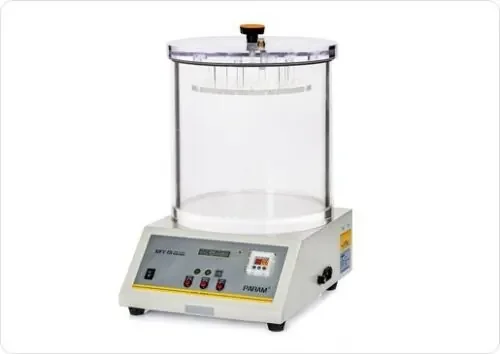
A vacuum leak tester challenges the whole pack, not just the seal.
Choosing the right method
Each method has different capabilities and limitations, and no single method covers every package. The right choice depends on:
- The packaging material and construction: film, laminate, rigid tray, blister, pouch, bottle or closure.
- The package design: where the seals sit, whether there is headspace, and how the pack behaves under a pressure difference.
- The expected defect: a pinhole, a channel in a seal, a cracked corner or a leaking closure.
- The sensitivity required: the smallest defect that actually matters to the product.
- The applicable test procedure: the method, standard or regulatory requirement the laboratory works to.
- Whether the pack must survive the test: non-destructive methods let the same sample go on to other checks.
Leak testing is not seal strength testing
Leak testing and seal strength testing are not the same thing, and one does not replace the other.
Leak testing evaluates package integrity: whether a path exists through which gas or liquid can pass. Seal strength testing measures the force required to separate a sealed interface under specified conditions.
The two properties come apart. A strong seal can still leak through a channel beside the seal area, and a weak seal can be leak-free on the day of the test. Depending on the product, both may be necessary: for a sterile barrier system, integrity and strength support different parts of the same validation argument.
A tensile tester with the right grips covers heat seal strength, peel and tensile work on the same bench as the leak tester.
Why manufacturers prioritise leak testing
- Protect product quality. A sound pack keeps oxygen, moisture, light and microorganisms away from the product.
- Identify packaging defects early, while the cause is still on the line and cheap to correct.
- Reduce waste and product losses, including the cost of a rejected batch and the investigation it triggers.
- Investigate sealing and manufacturing problems with evidence instead of assumption.
- Improve consistency across shifts, machines and material lots.
- Support defined quality control requirements, including the integrity clauses of customer specifications and the standards the site is audited against.
The standards behind the methods
A method name is shorthand; the procedure is what makes a result defensible. Common references include:
- ASTM F2338, non-destructive detection of leaks in packages by vacuum decay.
- ASTM D3078 and ASTM F2096, bubble emission methods for flexible and non-porous packaging.
- ASTM F1929, dye penetration for seal leaks in porous medical packaging.
- ISO 11607-1 and ISO 11607-2, which set out integrity requirements and process validation for packaging for terminally sterilized medical devices.
The edition of the standard, the test conditions, the sample size and the acceptance limit belong in the method, not in a conversation. A leak test that another analyst cannot repeat is not a quality record.
Packaging test equipment
Applied Analytical Systems supplies Labthink packaging test instruments in Nigeria: a vacuum leak tester for packs of food, drugs, medical devices, household chemicals and electronic parts, plus tensile, coefficient of friction, tearing, thickness and rub testers for the rest of the packaging specification.
If you are setting up a packaging integrity method, choosing between leak testing and seal strength testing, or replacing a tester that no longer meets the method, our engineers can specify the instrument and the procedure together. Contact us at aas@aasnig.com to discuss your packaging testing equipment requirements.
Frequently asked questions
- What is packaging leak testing?
- Packaging leak testing evaluates whether a package leaks under specified test conditions, or whether it meets defined integrity requirements. A sample pack is challenged with a pressure difference, a vacuum, a dye solution or internal pressure, and the test looks for evidence that gas or liquid has passed through a path it should not.
- What is the difference between leak testing and seal strength testing?
- Leak testing evaluates package integrity, meaning whether a path exists for gas or liquid to pass through. Seal strength testing measures the force required to separate a sealed interface under specified conditions. A strong seal can still leak through a channel beside it, so depending on the product both tests may be necessary.
- Which packaging leak test method should I use?
- It depends on the packaging material, the package design, the expected defect, the sensitivity required and the applicable test procedure. Vacuum decay is non-destructive and quantitative, bubble emission locates gross leaks, dye penetration checks a seal directly, and pressure-based methods suit closures and packs with headspace.
- Is vacuum decay leak testing non-destructive?
- Yes. Vacuum decay testing measures the pressure rise in an evacuated chamber over a defined time, so the pack is not opened, pierced or immersed. That lets the same sample go on to other checks and makes the method suitable for sample verification and method development.
- Which standards apply to packaging leak testing?
- Common references include ASTM F2338 for vacuum decay leak detection, ASTM D3078 and ASTM F2096 for bubble emission, ASTM F1929 for dye penetration in porous medical packaging, and ISO 11607-1 and ISO 11607-2 for packaging of terminally sterilized medical devices.