
Nov 9, 2026 · 4 min read
If you work with gas chromatography, you will meet several types of detector. Two of the most common are the Flame Ionization Detector (FID) and the Electron Capture Detector (ECD).
Both detect compounds as they leave the GC column, but they work on completely different principles and suit completely different compounds. So what exactly is the difference between FID and ECD?
What a GC detector does
The sample is injected into the instrument and separated into its individual components by the column. As each compound exits the column it passes through the detector.
The detector converts the presence of the compound into an electrical signal, and the GC system turns that signal into a chromatogram. Different detectors respond better to different classes of compound, which is why the choice of detector is an analytical decision, not an accessory choice.
Flame Ionization Detector (FID)
The FID is one of the most widely used GC detectors, particularly for organic compounds.
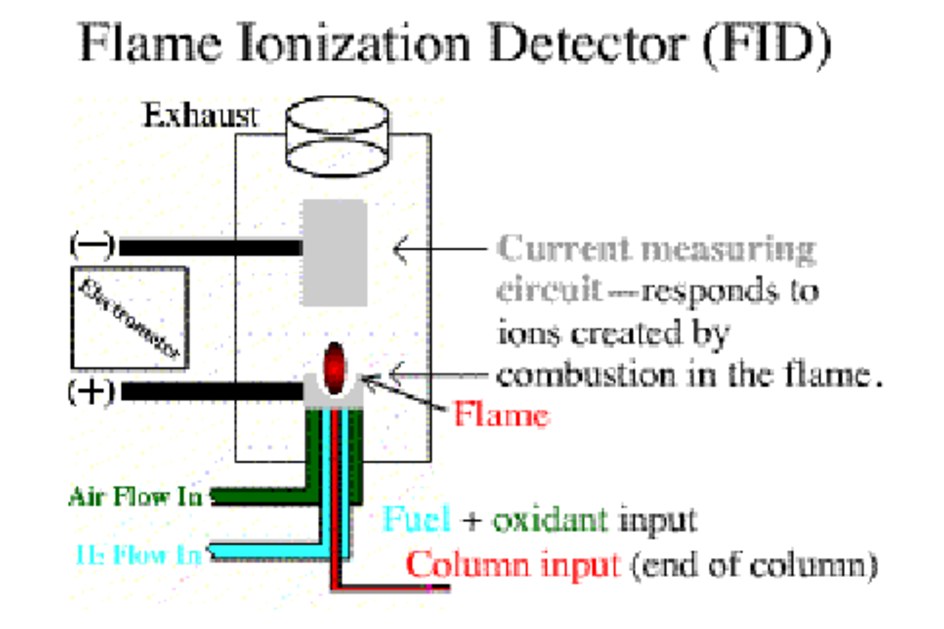
How it works. Compounds leaving the column are mixed with hydrogen and air and burned in a small flame. Organic compounds entering the flame produce ions, and those ions create a small current between electrodes in the detector. The instrument measures that current and converts it into a signal that appears as a peak on the chromatogram.
Organic compound, combustion, ions produced, electrical current, detector signal: that is the whole chain.
What FID detects. The FID responds to compounds containing carbon-hydrogen bonds, which makes it the standard choice for:
- Hydrocarbons
- Solvents
- Alcohols
- Organic acids
- Fuels and petroleum products
- Volatile organic compounds (VOCs)
It is at its most useful where hydrocarbons and other organic compounds are the main interest. It responds poorly to compounds with no C-H bonds, such as water, carbon dioxide and permanent gases.
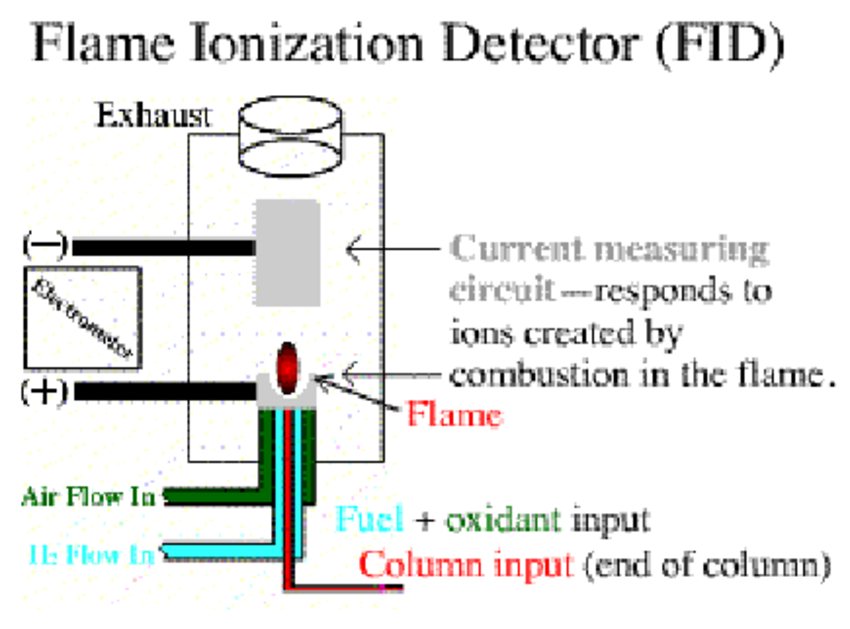
In an FID, the column eluent is burned in hydrogen and air, and the ions produced are collected as current.
Electron Capture Detector (ECD)
The ECD works on a different principle entirely. Instead of burning the sample, it uses a radioactive source, traditionally nickel-63 in many conventional designs, to generate electrons. When certain compounds enter the detector they capture those electrons, the standing electron current falls, and that change is measured as the detector response.
Electron source, electrons produced, compound captures electrons, current decreases, detector signal.
What ECD detects. The ECD is highly sensitive to compounds containing electronegative atoms or functional groups, especially:
- Halogenated compounds
- Chlorinated pesticides
- Organochlorine compounds
- Some brominated compounds
- Certain nitro compounds
Because of that selectivity, the ECD is closely associated with environmental and pesticide analysis, where organochlorine pesticides are a classic application.
FID vs ECD at a glance
| Flame Ionization Detector (FID) | Electron Capture Detector (ECD) | |
|---|---|---|
| Principle | Combustion of organic compounds in hydrogen and air | Capture of electrons from a radioactive source |
| Responds to | Carbon-hydrogen bonds | Electronegative atoms and groups |
| Strongest classes | Hydrocarbons, solvents, fuels, VOCs | Halogenated and organochlorine compounds, certain nitro compounds |
| Selectivity | Broad | High, and narrow |
| Typical use | Petroleum, fuels, solvents, general organic analysis | Environmental and pesticide analysis, trace halogenated compounds |
Which detector is better?
There is no simple answer. FID is not automatically better than ECD, and ECD is not automatically better than FID.
The right detector depends on:
- Which compounds you are analysing. Hydrocarbons point to an FID; halogenated compounds point to an ECD.
- The concentration levels you expect. Trace work at very low levels changes the calculation, and so does detector sensitivity for your specific analytes.
- How much selectivity you need. An ECD can pick chlorinated compounds out of a complex matrix that an FID would report as an unresolved crowd of peaks.
- The purpose of the analysis. Screening, quantification and confirmatory work have different requirements.
- The method or regulatory requirement you follow. Many methods name the detector, and that settles the question.
The detector should be selected from the analytical method and the properties of the compounds being measured, not from a preference for one instrument.
Practical selection
A useful way to settle the choice is to write down the target analytes and the matrix, then ask which detector responds to the analytes and does not respond to the matrix.
For a petroleum or solvent sample where the analytes are hydrocarbons, the FID is the natural default: broad response, wide linear range, and it ignores water and permanent gases. For organochlorine pesticides in an environmental extract, the ECD gives the selectivity and low-level response the method expects.
Some laboratories run both, using the FID for the organic profile and the ECD for the electronegative targets, either on separate instruments or through a split to two detectors on one system.
Final thoughts
Understanding GC detectors is part of working with gas chromatography.
The FID is a versatile detector with excellent response to many organic compounds, which keeps it the default for hydrocarbons, fuels, solvents and VOC-related applications. The ECD is highly selective and sensitive to compounds that capture electrons, which makes it particularly valuable for halogenated compounds and certain pesticide analyses.
So when you decide between FID and ECD, do not begin with "which detector is better?". Begin with "which detector is better for the compounds and the analytical method I am using?". That is the question that leads to the right choice.
GC systems and detector support
Applied Analytical Systems supplies PG Instruments gas chromatographs and supports GC installations in Nigeria, including detector selection, method advice, installation, training and repair. If you are configuring a GC for a new method or adding a detector to an existing system, contact us at aas@aasnig.com.
Frequently asked questions
- What is the main difference between an FID and an ECD?
- The FID burns the column eluent in a hydrogen and air flame and measures the ions that organic compounds produce. The ECD uses a radioactive source to generate electrons, and measures the drop in electron current when electronegative compounds capture them.
- Which detector is better for hydrocarbons, FID or ECD?
- The FID. It responds broadly to compounds containing carbon-hydrogen bonds, which makes it the standard choice for hydrocarbons, solvents, alcohols, fuels and volatile organic compounds.
- What is an ECD best used for?
- The ECD is highly selective for compounds containing electronegative atoms, especially halogenated and organochlorine compounds. That makes it a common choice for environmental and pesticide analysis, such as organochlorine pesticide residues.
- Does an FID detect water?
- No. The FID responds poorly to compounds with no carbon-hydrogen bonds, so water, carbon dioxide and permanent gases give little or no response. That is an advantage when the matrix is aqueous.
- Can one GC run both a flame ionization and an electron capture detector?
- Yes. Some laboratories use the FID for the organic profile and the ECD for electronegative targets, either on separate instruments or by splitting the column effluent to two detectors on one system.